

 2026.04.27
 Industry News
Content
A fresh pair of sneakers can define an entire outfit. For serious collectors and everyday wearers alike, keeping kicks clean is not a chore — it is a ritual. Shoe cleaning wipes have become the go-to tool for quick maintenance, but one rule applies before you open the packet: the material on your shoe determines everything about how you clean it. Use the wrong technique on the wrong surface and you risk water stains, color bleed, scratched coatings, or permanently matted texture. This guide breaks it down by material so you always know exactly what to do.
Most sneakers combine two or more materials across the upper, overlays, tongue, lining, and sole. Before reaching for a wipe, take ten seconds to identify what you are actually cleaning. The most common materials fall into two broad categories: forgiving surfaces that handle light moisture well, and sensitive surfaces that require a dry or near-dry approach.
| Material | Wipe Compatible? | Key Risk to Watch |
|---|---|---|
| Smooth leather | Yes | Drying out without conditioning |
| Patent leather | Yes — with care | Micro-scratches from grit |
| Canvas / fabric | Yes | Water staining if over-saturated |
| Mesh / knit uppers | Yes — light pressure only | Fiber snag, color bleed |
| Synthetic leather / TPU | Yes | Solvent-based wipes lifting edge seams |
| Suede / nubuck | Dry wipe only — test first | Moisture permanently changes texture |
| Rubber sole / midsole | Yes — ideal surface | Very low risk; textured wipes excel here |
With the table as your reference, the sections below cover each material in detail — what works, what to avoid, and the specific wiping technique that gets results without causing damage.
Smooth leather is one of the most wipe-friendly sneaker materials. Its sealed surface resists moisture absorption, which means a damp wipe can lift surface dirt, scuff marks, and oils without penetrating the material. The result is immediate — leather responds visibly to cleaning, restoring a clean, subtle sheen in a single pass.
The process is straightforward. First, gently blow on the surface or tap it with a dry cloth to remove any loose grit. Dragging trapped particles across leather — even with a soft wipe — creates fine scratches over time. Then open the wipe and use light, straight strokes from toe to heel, following the natural grain of the leather. Do not scrub in circles. Finish by allowing the surface to air-dry for thirty seconds before wearing or storing.
Patent leather demands extra caution. Its high-gloss lacquer finish is even more susceptible to micro-abrasions than standard smooth leather. Always remove loose debris first, use minimal pressure, and never fold the wipe to create a hard edge. A conditioning step after cleaning is recommended for regular leather uppers — it keeps the material supple and prevents the surface from drying and cracking over time.
Canvas sneakers are casual wardrobe staples, but their woven structure creates a hidden challenge: the open weave absorbs dirt and moisture deeply into the fiber, making stains harder to lift once they set. Shoe cleaning wipes are effective on canvas for fresh, surface-level dirt — the kind picked up during a commute or a quick outdoor walk. For deeply embedded stains or heavy soiling, a brush-and-solution approach will outperform a wipe alone.
When using a wipe on canvas, apply light pressure and work in one direction along the weave rather than scrubbing back and forth. The goal is to lift dirt to the surface rather than push it deeper into the fabric. Avoid wringing out excess moisture from the wipe onto the shoe — a well-formulated cleaning wipe is pre-saturated at the right level and should not require additional liquid. Over-wetting canvas can leave tide marks as the water evaporates, which are difficult to remove.
White canvas is particularly unforgiving. Any excess cleaner or residue left on the surface will show as yellowing once dried. Use the wipe quickly and allow the shoe to air-dry in a shaded spot away from direct sunlight or heat, both of which can cause the canvas to shrink slightly or develop permanent discoloration.
Performance running shoes and lifestyle sneakers built on knit platforms — including Flyknit, Primeknit, and similar engineered mesh constructions — are among the trickiest materials to clean. The open, interlocking fiber structure catches and holds fine dirt particles while remaining sensitive to both friction and moisture.
The technique here shifts from wiping to gentle pressing. Instead of dragging the wipe across the surface, press it lightly against the soiled area and lift. Repeat as needed, using a fresh section of the wipe each time. This blotting motion pulls dirt out of the knit without snagging or deforming the fibers. Aggressive rubbing can permanently distort the weave pattern and cause pilling — a visible, irreversible texture change that no amount of cleaning will fix.
Pay attention to color. Knit uppers with gradient dye or multi-color patterns can bleed if the cleaning formula is too aggressive. Always use a pH-neutral wipe formulated without harsh solvents. If you are cleaning a pair for the first time, test the wipe on a small hidden section — inside the tongue or near the heel collar — and wait sixty seconds to confirm there is no color transfer before proceeding to the rest of the upper.
Many modern sneakers combine genuine leather with synthetic panels — TPU (thermoplastic polyurethane) overlays, PU-coated panels, or bonded synthetic leather. These materials mimic the look of leather at a lower cost and with higher durability, but their construction has a specific vulnerability: the seams and edges where synthetic panels meet the underlying material.
Wipes are highly compatible with the flat surfaces of synthetic leather. The material does not absorb moisture, cleans quickly, and shows immediate results. The risk lies in the formula. Solvent-based wipes — those containing high concentrations of alcohol, acetone, or aggressive degreasing agents — can seep into seam edges and weaken the adhesive bond between layers. Over time, this causes peeling and delamination along panel borders.
Stick to pH-neutral, alcohol-free or low-alcohol wipes for any sneaker with bonded synthetic construction. Wipe the flat panel surfaces with confidence, but keep the wipe away from raised stitching lines and glued edges. Use a dry cotton swab to clean those narrow zones instead.
This is the most important section in this guide. Suede and nubuck are the materials most commonly damaged by improper cleaning — and shoe cleaning wipes are a significant risk factor if used incorrectly.
Both suede and nubuck are produced by abrading the surface of leather to create a soft, fibrous nap. That fine surface texture is what gives these materials their distinctive matte finish. It is also what makes them hypersensitive to moisture. When water or a wet wipe contacts suede, the moisture causes the fibers to clump, mat down, and dry in a stiff, discolored formation. The original soft texture does not fully recover after this happens. Water stains and tide marks on suede are notoriously difficult to remove and often require professional restoration.
A dry shoe cleaning wipe — meaning a wipe that is barely damp or has had most of its moisture allowed to evaporate for a few seconds after opening — can be used to gently lift very light surface dust from suede or nubuck. The technique is a light, single-direction brush rather than a scrubbing motion. Never apply pressure. If the surface feels even slightly damp after contact, stop immediately.
For any serious dirt, scuffs, or stains on suede, the correct tools are a dedicated suede brush and a suede eraser. Wet wipes — even specialized ones — are a last resort on these materials, not a first choice. When in doubt, do not wipe.
If smooth leather is wipe-friendly, rubber soles are the easiest surface of all. Vulcanized rubber outsoles, EVA midsoles, and TPR toe caps are durable, non-porous, and almost entirely resistant to the chemical and abrasive risks that affect upper materials. This is where shoe cleaning wipes deliver their most satisfying results.
Yellowed midsoles, scuffed toe boxes, and road grime embedded in sole grooves all respond well to wipe cleaning. For flat midsole panels, a standard non-woven wipe with a mild surfactant formula will restore clean white rubber in seconds. For the textured grooves and lugs of an outsole, a wipe with a granular dot or textured surface provides the friction needed to dislodge packed-in dirt without any extra tools.
The practical tip here: always clean the soles last. If you wipe the upper first and then move to the sole, any residual dirt from the sole can transfer back onto the cleaned upper. Work from the top of the shoe down to the sole and finish with the outsole as the final step.
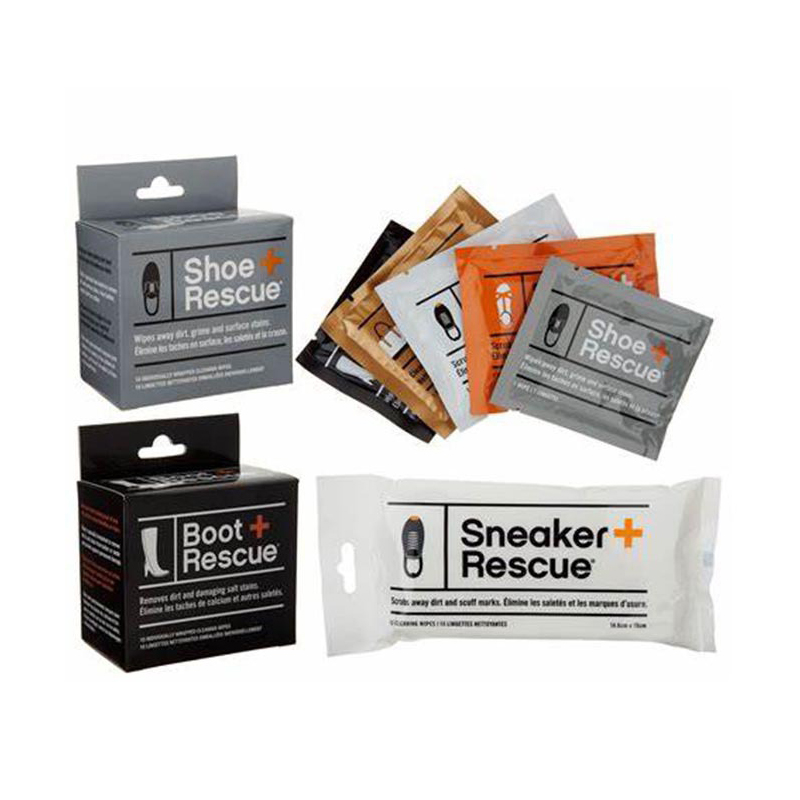
Not all shoe cleaning wipes are created equal, and the difference between a generic wet wipe and a purpose-built sneaker wipe is significant. Baby wipes and household cleaning wipes may seem like convenient substitutes, but their formulations are optimized for skin or hard surfaces — not shoe materials. Using them risks color changes, sticky residue, and premature coating breakdown.
Two main substrate options are available in quality shoe cleaning wipes, and each has its strengths:
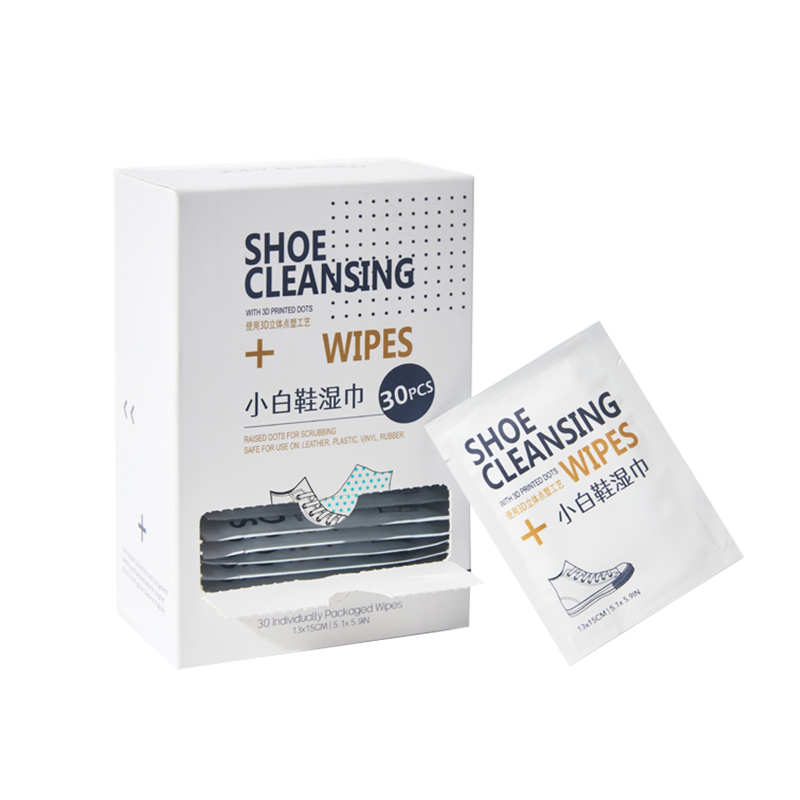
Regardless of substrate type, the formula should be pH-neutral, free of ammonia and aggressive solvents, and pre-moistened at a level that cleans effectively without over-wetting the shoe. Individual foil packaging ensures every wipe is at the correct saturation when opened — loose tub formats allow wipes to dry unevenly and may introduce contamination between uses.
For brands, retailers, and footwear companies looking to offer co-branded or private-label shoe care accessories, wet wipes OEM customization allows full control over formula, substrate, packaging size, and branding — a growing category as sneaker care becomes a mainstream consumer interest. Unlike generic household cleaning wipes, shoe-specific formulations are developed with material compatibility testing as a core requirement, not an afterthought.
The right wipe, applied with the right technique to the right material, keeps sneakers looking sharp between deeper cleaning sessions — and extends the life of the shoe far beyond what careless or improvised cleaning ever could.

Wet Wipes OEM/ODM, Custom Wet Wipes Manufacturers in China. We are making wet wipes enter every household and become an essential part of our daily life, and are making unremitting efforts to create a cleaner and more comfortable home environment.
Read MoreFor exclusive deals and latest offers, sign up by entering your email address below.


 English
 русский
 عربى
عربى